What about your families – were they just as supportive?
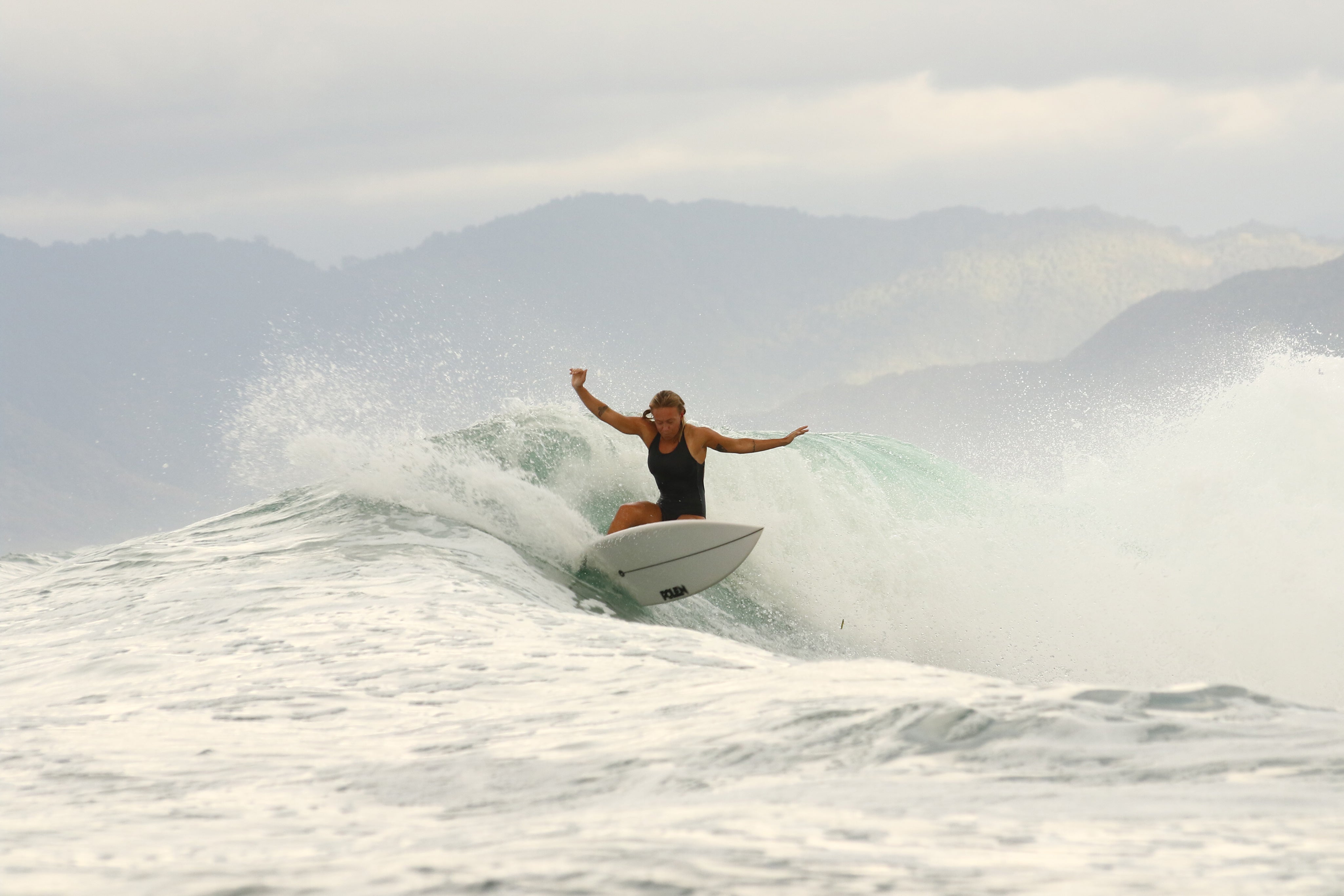
Iis: At first, no, they weren’t supportive at all. My parents were busy working on a nearby farm, while I spent all my time surfing whenever I could. Of course, they found out at some point, and when they did, I got scolded a lot. After that, my mom would even show up with a wooden stick on the beach whenever she caught me surfing. I think every kid probably went through something like this back then. It was my parents’ way of showing concern for me and my future, as they saw surfing as something not likely to lead to much success and as something for kids who were a little too free-spirited. But to be honest, that only made me more determined. It motivated me to prove to them—and to everyone—that girls can surf too. And it made me stronger.
Reni: It’s clear that our 13-year age gap shaped our experiences as female Indonesian surfers in very different ways, especially when it comes to family support. By the time I started surfing, it wasn’t as rare to see girls catching waves. And while Iis’s parents initially were strictly against it, mine were the complete opposite – in fact, they even encouraged me to start surfing! It really shows how much progress we’ve made in such a short time, and it fills me with happiness and hope for the future of female surfers in Indonesia!
What other challenges have you both faced, or are you still facing, today?
Iis: Many neighbors and people from my community would comment on my skin tone. I already had naturally tanned skin, and being in the water every day made my skin even darker. I didn’t mind at all, but unfortunately, dark skin wasn’t – and still isn’t to some extent – considered beautiful. The Indonesian beauty standard is heavily influenced by the media, where most women are portrayed as fair-skinned with straight hair and slim figures. So, it was hard not to listen to those comments from time to time. To this day, there is also still a noticeable gap between male and female surfers in Indonesia. For example, there are far fewer competitions for women than there are for men. But when I think about how things were 20 years ago, I’m proud of how far we’ve come.
Reni: I agree; there are still clear differences between male and female surfers in Indonesia. There are far more events for men, with more categories and more frequent competitions, and it’s generally easier for guys to get sponsorships—which can be frustrating.
On a personal level, I also face pressure to dress "appropriately" in the water, since we live in a Muslim community. I’ve had countless discussions with my father because he disagreed with the choice of what I’m wearing while surfing. When I wear clothes that are considered more revealing by West Java standards, I feel more comfortable and confident. Surfing is not only something I love, but it’s also my primary source of income, so it’s important for me to feel at ease during competitions. My father and I had many long conversations about this, and over time, he started to understand my point of view. We eventually came to the understanding that what I wear while surfing is like my work uniform. Outside the water, I dress differently.
What are some of the best things surfing has brought into your life?
Iis: Well, apart from finding something I truly enjoy doing and the fact that it makes me feel strong and confident, there’s one thing that stands out as the undoubtedly best gift surfing has given me: I met my husband while we were both catching waves, and together we have a daughter who’s now starting to surf and loves it just as much! Watching her experience surfing as a young female Indonesian is incredible. It’s so important to me not only to encourage her but also to help her understand that, like me, she will face comments about her dark skin. I want her to grow up knowing that there are far more important things in life than the color of your skin.
Reni: I do what I love, and I truly enjoy every moment of it. Surfing has brought so many exciting experiences into my life, especially the chance to meet people from all over the world. I’m surrounded by a supportive community, and I’m passionate about encouraging other girls to give surfing a try. Let’s not be afraid of getting tanned, facing bullies, or feeling insecure – this is absolute nonsense. In fact, it’s cool to be tanned!